
Free beginner workbench
9 V battery, USB or wall adapter?
Compare three beginner power sources with a worked LED example, safe connector checks and clear low voltage limits.
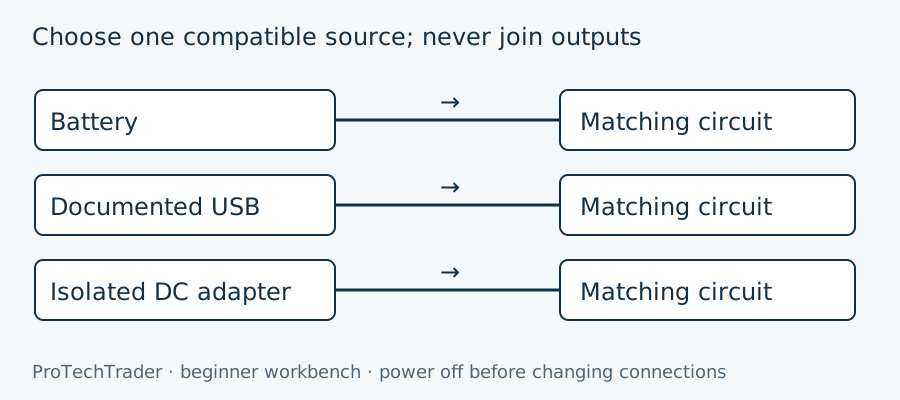
A power source must match the circuit, not just fit its connector. A small battery, a USB output and the low voltage output of an enclosed wall adapter can all be useful, but they are not interchangeable. This exercise compares them for a simple indicator and teaches a source selection checklist. For the broader selection reference, including connector and regulation details, use the existing power supply guide below. Never connect a breadboard to mains wiring or open a wall adapter.
Write the circuit's requirements first
Record the required DC voltage, estimated current, polarity and connector. Check every part that is connected to the supply, including chips, sensors and capacitors. A single part with a lower voltage limit can decide the safe supply for the whole circuit. If the guide specifies one source, use that source until you understand why it was chosen. A familiar battery clip is not evidence that the load is designed for that battery.
A current rating on a regulated constant voltage adapter states the available capacity. It does not force that much current through every load. The load draws according to its circuit behaviour, provided the supply is operating normally within its limits. Excess capacity can still make a short circuit more destructive, so current limiting, suitable wiring and protection matter. A battery also can deliver damaging fault current; “battery powered” is not another word for harmless.
The small rectangular battery
A nominal 9 V battery is convenient for a portable low current project with a suitable design. Its terminal voltage changes with condition and load. It is usually a poor choice for a motor or a load demanding sustained high current. Cover loose terminals during storage and keep metal tools away from them. Use an intact clip with the correct polarity and do not let stripped leads touch.
For an LED exercise, assume a 2 V forward drop and target 10 mA. The ideal series resistance is (9 − 2) / 0.010 = 700 Ω. An 820 Ω resistor gives about 8.54 mA at those nominal voltages. Its power is 7² / 820 = 0.0598 W. Those calculations describe this indicator only, not how to power an arbitrary board labelled with the same connector.
A USB source
A basic USB power output is nominally 5 V, but connector systems can support other negotiated modes. Use a reputable enclosed source and a documented breakout or cable designed to deliver the voltage your circuit needs. Do not use an unknown trigger board or assume that a connector shape proves the voltage. Keep the computer disconnected during a first experimental power-up if a separate documented supply is available.
At an assumed 5 V and the same 2 V LED, the ideal resistance for 10 mA is (5 − 2) / 0.010 = 300 Ω. A 330 Ω resistor gives about 9.09 mA and dissipates 3² / 330 = 0.0273 W. A resistor chosen for the battery will still limit current on this lower supply, but brightness changes. Recalculate whenever the source or load changes; do not bridge different supplies together to see which one wins.
An enclosed wall adapter
Use only an intact, appropriately certified, isolated adapter with a documented low voltage DC output. Leave its mains side enclosed. Confirm output voltage, available current, polarity, connector dimensions and whether the output is regulated. Some adapters deliver AC; that is not a substitute for DC. A plug that slides into a socket can still have the wrong electrical polarity or dimensions.
For a documented 5 V circuit drawing 30 mA, a compatible regulated 5 V adapter rated 1 A has capacity above the load: 1 A = 1,000 mA. Estimated load power is P = VI = 5 × 0.030 = 0.150 W. This arithmetic alone does not approve an adapter; the remaining compatibility and protection checks still apply. With the load disconnected, measure the output if you have the right equipment and know the safe meter procedure.
Common mistakes
- Choosing a supply by connector fit or current rating alone.
- Connecting 9 V directly to a circuit designed for 5 V.
- Combining battery and USB power without a documented power selection circuit.
- Assuming a selectable adapter stayed at its previous setting.
- Measuring current by placing the meter across the source.
Choose, connect, observe
Set up with the source disconnected. Verify the board wiring and polarity, then connect a single documented source. Watch for unexpected heat, smell, excessive current or unstable behaviour and disconnect immediately if any appears. Stop rather than raising the voltage to make a reluctant circuit work. Recharge only cells and packs specifically designed for the correct charger; this exercise does not cover lithium cell charging or battery pack construction.
TechCrate Volume 001's parts list calls for the breadboard, battery, clip and jumpers from the Starter Kit. The separate clip and board links below help identify those accessories; they are not a promise that each monthly envelope includes another battery. Use the power supply calculator for estimates, then compare its result with the documented source requirements. ALAI can help explain a label or calculation, but it cannot certify an unknown adapter from an unclear photograph.
Continue at your workbench
ALAI is a member AI assistant and can be wrong. Digital VIP or an active TechCrate subscription is required for member answers. Low voltage hobby electronics only; no mains work.
Existing guides for the background
- How to Choose a Power Supply for Electronics Projects
- Electronics Safety & Best Practices - Complete Safety Guide
- How to Use a Digital Multimeter for Electronics
