
Best Electronics Books for Beginners (2026)
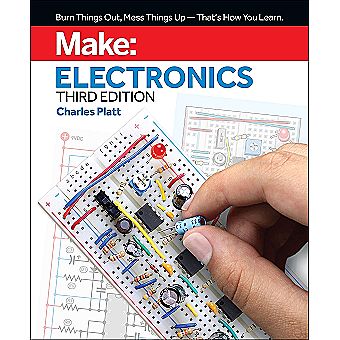
For most beginners learning by doing in 2026, our first choice is Make: Electronics, 3rd Edition by Charles Platt. Choose Make: Easy Electronics for a gentler start without tools. The best fit depends on whether you want guided experiments, visual explanations, or a reference to consult while building your own circuits.
ProTechTrader is a family-owned US electronics store in New Jersey, serving builders since 2013. We assemble companion component kits for Charles Platt's Make: Electronics books. That shapes our advice: choose a book whose approach you like, then match the parts to it.
If you found an electronics books 2025 list, many recommendations still apply. The fundamentals have not changed. For electronics books in 2026, judge the teaching style, prerequisites, and parts requirements before the publication year.
The two books we stock

Compare nine books to learn electronics
These recommendations group books by learner type. Some lead you through experiments. Others explain components or help you make design decisions. You do not need all nine.
| Book | Level | Style | Needs parts? |
|---|---|---|---|
| Make: Electronics, 3rd Edition | Beginner onward | Guided experiments | Yes, for experiments |
| Make: Easy Electronics | Complete beginner | Simple practical experiments | Yes; no tools required |
| Getting Started in Electronics | Beginner | Illustrated explanations and circuits | Yes, to build circuits |
| Electronics For Dummies | Beginner | Explanations and practical exercises | Yes, for exercises |
| Make: More Electronics | Beyond the basics | Experiments followed by theory | Yes |
| Practical Electronics for Inventors | Beginner to intermediate | Broad technical guide | For practical work |
| The Art of Electronics | Intermediate onward | Circuit design and reference | For practical investigation |
| Encyclopedia of Electronic Components | All levels, as a reference | Component lookup | No, for reading |
| Make: Radio | Beginner with some circuit experience | Radio projects and explanations | Yes |
Which electronics book fits you?
1. Make: Electronics, 3rd Edition: for learning through experiments
Charles Platt's Make: Electronics book is our main recommendation for an adult or student who wants to build, observe, and understand. It introduces fundamental components through experiments, with explanations that connect circuit behavior to the underlying ideas.
You need the specified parts, suitable low-voltage power, and tools as the experiments require them. Allow time to check connections and investigate mistakes. This approach suits readers willing to work through a sequence. Someone seeking a quick component lookup will want a reference alongside it.
2. Make: Easy Electronics: for a gentler first step
Make: Easy Electronics, also by Charles Platt, suits readers who want practical experiments before setting up a workbench. Its experiments require components but no tools. That makes it worth considering if buying equipment feels like too much commitment at the start.
Use the matching component pack and follow the book's instructions. Choose it for an approachable introduction. Choose Make: Electronics when you want a broader learning path that develops your use of tools and circuit-building techniques.
3. Getting Started in Electronics: for visual learners
Forrest M. Mims III uses distinctive hand-lettered pages, drawings, and circuit diagrams to introduce electronics. This compact book suits someone who likes seeing ideas laid out visually and wants circuits to study and build.
Have a breadboard, appropriate components, battery power, and a multimeter available for practical work. Buy parts for selected circuits rather than guessing at an assortment. Its compact explanations may need a second source when a subject does not click. Preview a few pages to see whether the presentation suits you.
4. Electronics For Dummies: for plain-language explanations
Electronics For Dummies suits readers who want terminology explained alongside practical instruction. Cathleen Shamieh's third edition covers fundamentals, components, schematics, tools, measurement, and projects. It offers a broad introduction without assuming you already have a workbench.
You need parts and tools for the exercises you choose. Read those requirements before shopping. This is a useful option if you prefer explanations organized by topic, with practical work alongside them. Compare a sample chapter with Platt's approach before choosing your first book.
5. Make: More Electronics: for your next round of experiments
Charles Platt's Make: More Electronics is for readers who have worked through Make: Electronics or already understand similar material. It continues the practical approach: build circuits, observe what happens, then explore the theory behind them.
Expect to source additional components. Your first book's kit is not a substitute for this book's parts list. Keep your breadboard, multimeter, tools, and experiment notes handy. If basic circuit diagrams still feel unfamiliar, spend more time with an introductory book before moving on.
6. Practical Electronics for Inventors: for a broader technical foundation
Paul Scherz and Simon Monk cover components, circuit behavior, and practical design in Practical Electronics for Inventors. It suits a motivated beginner who wants more technical detail, or someone who has built projects and wants to understand their design choices.
Keep paper and a calculator nearby. For practical work, gather components and equipment for the circuit you are studying. Use it chapter by chapter or consult relevant sections during a project. Its breadth makes it a substantial commitment as a first book.
7. The Art of Electronics: for readers moving toward circuit design
Paul Horowitz and Winfield Hill's The Art of Electronics is a substantial guide to electronic circuit design. It suits readers ready to examine how circuits work, why designers choose particular arrangements, and what practical limits matter.
Most complete beginners should build some basic circuits first. You can read it without equipment, but investigating circuits requires suitable parts and instruments. Some work may call for an oscilloscope. Buy equipment as your learning requires it, rather than treating a full laboratory as an entry requirement.
8. Encyclopedia of Electronic Components: for answering component questions
Charles Platt's Encyclopedia of Electronic Components series explains what components do, how they work, and where they are useful. It suits learners who encounter an unfamiliar part and want a focused explanation.
No parts are needed to read it. Keep the relevant volume beside an experiment book, along with the manufacturer's datasheet for the exact part you use. The encyclopedia provides context; the datasheet supplies device-specific ratings and connections. It is a companion reference rather than a first-to-last experiment course.
9. Make: Radio: for learners interested in radio circuits
Make: Radio, by Fredrik Jansson, with illustrations by Charles Platt, suits readers drawn to radio and related practical projects. It combines building instructions with explanations of the ideas behind the circuits.
Some basic circuit experience will help. Gather the specified parts and tools for each project. Keep beginner work to low-voltage circuits, and check applicable rules before operating any transmitter. Choose this as a focused next subject if radio holds your attention more than another general electronics course.
Match the component kit to the book
A hands-on book needs parts. A generic assortment may lack a particular relay, chip, or component value. Match the title, edition, and experiment range. Check whether tools, batteries, and the book itself are included.
Make: Electronics, 3rd Edition
- Kit 1 Economy ($68.99) covers experiments 1–11.
- Kit 1 Deluxe with tools and double case ($119.99) covers experiments 1–11.
- Kit 2 Economy ($99.99) covers experiments 12–34.
- Kit 1 and Kit 2 bundle with tools and double case ($265.99) combines both kit stages.
For smaller purchases, choose the listed range: Mini Kit 1, experiments 1–5; Mini Kit 2, experiments 6–11; Mini Kit 3, experiments 12–14; Mini Kit 4, experiments 15–23; or Mini Kit 5, experiments 24–31. These ranges describe the kit listings. Check the contents against your copy before ordering.
Easy Electronics, More Electronics, and Radio
- Make: Easy Electronics: choose the component pack ($33.99) if you own the book, or the book and component kit bundle ($47.99).
- Make: More Electronics: Component Pack 1 ($89.99) follows experiments 1–14. It does not cover the whole book.
- Make: Radio: choose the Radio component kit or the Radio component kit and book bundle. Review the contents for your planned projects.
A sensible beginner reading order
- Choose one starting book. Pick Easy Electronics for a gentle introduction, or Make: Electronics for a longer practical path.
- Build and take notes. Record the circuit, expected result, measurements, and anything you changed.
- Add a reference when needed. Use Mims for another visual explanation or the encyclopedia for component questions.
- Follow your interest. Continue with More Electronics, study radio, or use Practical Electronics for Inventors to deepen your understanding.
- Move into design. Approach The Art of Electronics when you want to analyze and develop circuits.
For every beginner project, use only the specified low-voltage power source. Disconnect power before changing wiring. Check polarity and component ratings. Never connect a breadboard to household mains or open mains-powered equipment. Start with one book and one manageable experiment.
Common questions
What is the best electronics book for a complete beginner?
Make: Electronics, 3rd Edition is our pick for beginners who want to learn by building circuits. Make: Easy Electronics offers a gentler start with experiments that do not require tools.
Are electronics books recommended in 2025 still useful in 2026?
Yes. Basic circuit principles remain useful, though component availability and software instructions can change. Check the edition, parts list, and publisher's corrections before buying supplies.
Do I need a component kit to learn electronics from a book?
You need suitable parts to perform the experiments, but you can buy them separately. A matching kit helps with sourcing; check its contents, tool requirements, and experiment coverage.
Do I need advanced math before reading an electronics book?
You can begin with basic arithmetic and simple circuit experiments. Algebra becomes more useful as you calculate circuit values and move into design.
Is The Art of Electronics suitable as my first book?
It can suit a technically confident reader, but it is a demanding starting point for someone who has never built a circuit. Most beginners will benefit from an introductory experiment book first.
Does a Make: Electronics kit also match Make: More Electronics or Make: Radio?
Do not assume it does. These are separate books with different parts lists, so choose a component pack made for the specific title and check which experiments it covers.
Keep reading
- Best electronics kits for adults and engineering students (2026)
- Make: Electronics book guide
- Learn Electronics: free how-to guides
About this guide: ProTechTrader makes and sells the companion component kits for Charles Platt's Make: books, so links to our own products are commercial. Prices and stock for our products are read from the store when this page is rebuilt each night; the product page is always the final word.